
Mid-term review confirms strong progress in QuantERA Call 2021 projects
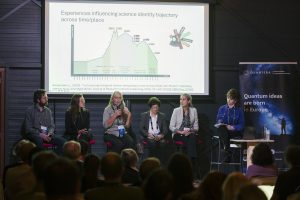
QuantERA Strategic Conference, Amsterdam. Photo by Kirsten van Santen
During the QuantERA Strategic Conference 2024 held in Amsterdam, a key objective was to monitor the progress of the QuantERA Call 2021 projects. At the midpoint of their implementation, the 39 projects showcased their achievements, demonstrating significant advancements towards the programme’s objectives in key quantum technologies (QT). Particular focus has been placed on quantum communication, quantum computing, metrology, and enhanced imaging, while also contributing to the development of scalable quantum hardware, novel architectures, and advanced algorithms.
As part of this mid-term evaluation process, a comprehensive review report summarised key findings, progress statistics, and emerging trends across the funded projects — highlighting the impact and direction of European quantum research.
Transnational collaboration strengthens research networks
The Call 2021 has been highly successful in fostering transnational collaboration. Notably, 87% of consortia involved new collaborations, and 71 new partnerships were established outside of the consortia during the implementation period. Additionally, all 16 projects in the field of Applied Quantum Science reported effective collaboration between academic and industrial partners.
Scientific excellence and innovation at the core of QuantERA
The funded projects have already produced:
– 410 peer-reviewed journal articles, with 199 accepted for publication
– 277 presentations at international conferences
– 10 new methods, 8 collaborative projects, 5 new products, and 2 international patents
These numbers are expected to grow significantly in the remaining duration of the projects, underlining the continued momentum and scientific relevance of the QuantERA programme.
Commitment to Responsible Research and Innovation (RRI)
QuantERA projects actively embrace the principles of Responsible Research and Innovation (RRI), integrating openness, inclusiveness, and societal engagement across their activities. Highlights include:
– 165 educational and outreach events
– Gender equality initiatives such as Girls’ Day
– Commitment to open science, with publications and data shared on platforms like ArXiv and Zenodo
 Project highlights: tangible progress across quantum research domains
Mf-QDS – Quantum Sensing with Nanodiamonds
The Microfluidics Quantum Diamond Sensor (Mf-QDS) project explores quantum sensing in microfluidic environments using NV-centres in diamonds. The consortium has developed tools for high-sensitivity molecular detection, with potential applications in nano-NMR and biophysics. One of the key scientific achievements includes a novel approach to understanding signal decay processes, which has been recognised in a peer-reviewed publication.
QOPT – Quantum Algorithms for Optimisation
The Quantum Algorithms for Optimisation (QOPT) project is advancing quantum algorithm design by addressing real-world optimisation problems. The team has implemented memory-efficient quantum techniques for applications in logistics, machine learning, and physics. Noteworthy results include new quantum primitives and computational methods for high-dimensional systems.
DISCO – Plasmonics and Quantum Emitters
The DISCO project has made significant strides in understanding the interaction between plasmonic modes and quantum emitters. Its experimental work includes successful fabrication of nanostructures and the development of advanced photonic devices. A publication in Nature Communications highlights the impact of the results within the scientific community.
 Looking ahead
The mid-term review confirms that QuantERA Call 2021 projects are firmly on track to deliver high-impact results across Europe’s quantum landscape. With strong scientific output, cross-border collaboration, and alignment with societal goals, the second half of the funding period promises further breakthroughs. These projects continue to shape the foundations of tomorrow’s quantum technologies — not only in theory and experimentation but also in their readiness to address real-world challenges.